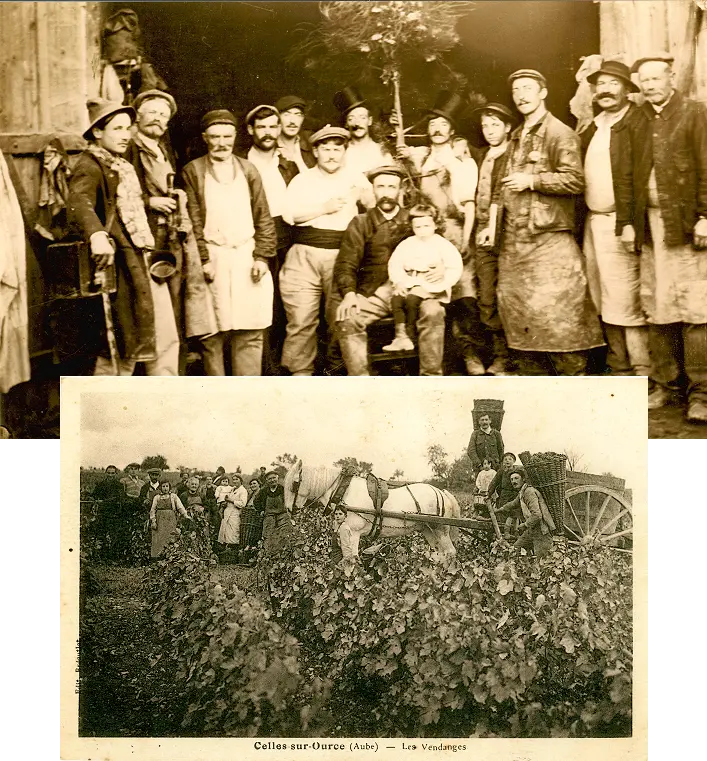
A family Champagne house with deep roots in the region's winegrowing history.
Founded at the end of the 17th century
It represents several generations who have passed down tradition and savoir-faire. The Cheurlin family settled in Celles-sur-Ource, a village in the Côte des Bar, one of Champagne’s sub-regions.
From the very beginning, the family devoted itself to vine growing. At the time, winegrowers mainly worked for larger houses or supplied still wines. However, with the rise of the traditional Champagne method, the Cheurlin family transitioned to Champagne production after the Second World War.
Today, Maison Thomas Cheurlin remains a family-owned, independent House, run by the descendants of the family line, including Thomas Cheurlin. It stands out for its commitment to environmentally responsible practices, promoting sustainable viticulture (HVE and VDC certifications).
The Champagnes are crafted from Champagne’s traditional grape varieties: Pinot Noir, Chardonnay, and also Blanc Vrai (Pinot Blanc), one of the region’s rare grapes. The guiding idea has always been to produce authentic Champagnes that showcase the richness of the Côte des Bar terroir.
Centuries of history
1677
An archival record from the Aube Department attests to the presence of a Cheurlin in Celles as a vine grower. This is where the Cheurlin family story begins, deeply rooted in the region’s winemaking tradition.
1788
A notarised deed shows that a member of the Dangin family purchased land in Celles. This marks the beginning of the Dangin family story, rooted in the Aube’s Champagne terroir.
1954
30 October 1954: wedding of Christiane Dangin and André Cheurlin.
1955/60
Acquisition of three houses in Celles-sur-Ource, serving as both family home and future professional workspace. Renovation works spread over five years, giving birth to the Estate. First extension created.
1961
André Cheurlin returns from Algeria and founds the Cheurlin-Dangin brand. The estate expands for the second time.
1996
The cellar is renovated and a visitor reception building is created. In the same year, Thomas completes his military service.
2000
Thomas joins the family estate after studying wine in Beaune.
2013
Creation of the new pressing centre.
2015
Purchase of amphorae.
2025
Thomas launches Champagne Vaucelle.
Centuries of history
1677
An archival record from the Aube Department attests to the presence of a Cheurlin in Celles as a vine grower. This is where the Cheurlin family story begins, deeply rooted in the region’s winemaking tradition.
1788
1954
1955/60
1961
1996
2000
A notarised deed shows that a member of the Dangin family purchased land in Celles. This marks the beginning of the Dangin family story, rooted in the Aube’s Champagne terroir.
30 October 1954: wedding of Christiane Dangin and André Cheurlin.
Acquisition of three houses in Celles-sur-Ource, serving as both family home and future professional workspace. Renovation works spread over five years, giving birth to the Estate. First extension created.
André Cheurlin returns from Algeria and founds the Cheurlin-Dangin brand. The estate expands for the second time.
The cellar is renovated and a visitor reception building is created. In the same year, Thomas completes his military service.
Thomas joins the family estate after studying wine in Beaune.
2013
Creation of the new pressing centre.
2015
Purchase of amphorae.
2025
Thomas launches Champagne Vaucelle.
STEP INTO OUR WORLD
Explore four captivating episodes that reveal the great stages of Champagne-making at Maison Thomas Cheurlin. From vineyard to cellar, our craftsmanship is captured in just a few minutes, bringing to life the gestures, precision, and passion that shape our Champagne. These films offer an inside look at the meticulous work behind every bottle.
« During trellising, we fasten the vine shoots to wires using clips to guide their growth. This ensures better exposure to sunlight, good air circulation, and helps the grapes ripen evenly. This step takes place in spring, usually between May and June. »
« We harvest by hand to preserve the integrity of the grape clusters. This gentle method ensures grapes of the highest quality, essential to the making of our Champagne. The harvest usually takes place in September, depending on the summer’s weather conditions. »
« Blending is a key stage in which we bring together different base wines, from various grape varieties or parcels. This is how we build the balance and the distinctive style of our House. It takes place during winter, between December and February. »
« Disgorgement involves removing the lees formed during the second fermentation. Then, each bottle is carefully dressed: the foil, muselet, and label complete its presentation. »